English
 Español
 عربى
 中文简体
Content
- 1 What Counts as an Agricultural Container?
- 2 The Six Structural Styles You Will Actually See
- 3 Materials: Where Most Buying Decisions Are Won or Lost
- 4 The Insulated Category Most Farms Overlook
- 5 Rotomolding, Injection Molding and Fiberglass Compared
- 6 Features Worth Checking Before You Commit
- 7 Matching Containers to Real Farm and Food Scenarios
- 8 A Step-by-Step Selection Path
- 9 Cleaning, Food Contact and Service Life
- 10 Custom Sizing, Branding and OEM Supply
- 11 Frequently Asked Questions
- 11.1 Are plastic agricultural containers food safe?
- 11.2 How long should an insulated container hold temperature?
- 11.3 Can containers be repaired if they crack?
- 11.4 Is insulated better than ordinary plastic?
- 11.5 What is the most common mistake buyers make?
- 11.6 Do containers work in both hot and cold climates?
Most equipment on a farm gets attention when it is bought and then quietly disappears into routine. Agricultural containers work the other way round. Nobody photographs a stack of bins, and yet those bins carry every crate of produce, every gutted fish, every pallet of frozen goods and every load of feed that moves across the property. When they fail — split corners, warped bases, insulation that stopped insulating two seasons ago — the cost does not appear on an invoice. It appears as spoilage, double handling and emergency replacement freight.
This guide comes from the shop floor rather than a catalogue. We build rotomolded insulated containers for food, fishery, cold-chain and farming customers in more than forty countries, and we have watched the same handful of purchasing mistakes repeat themselves across very different climates. Below you will find the structural styles you will genuinely encounter, the materials that decide whether a bin lasts three seasons or fifteen, and the questions worth asking before a purchase order is signed.
What Counts as an Agricultural Container?
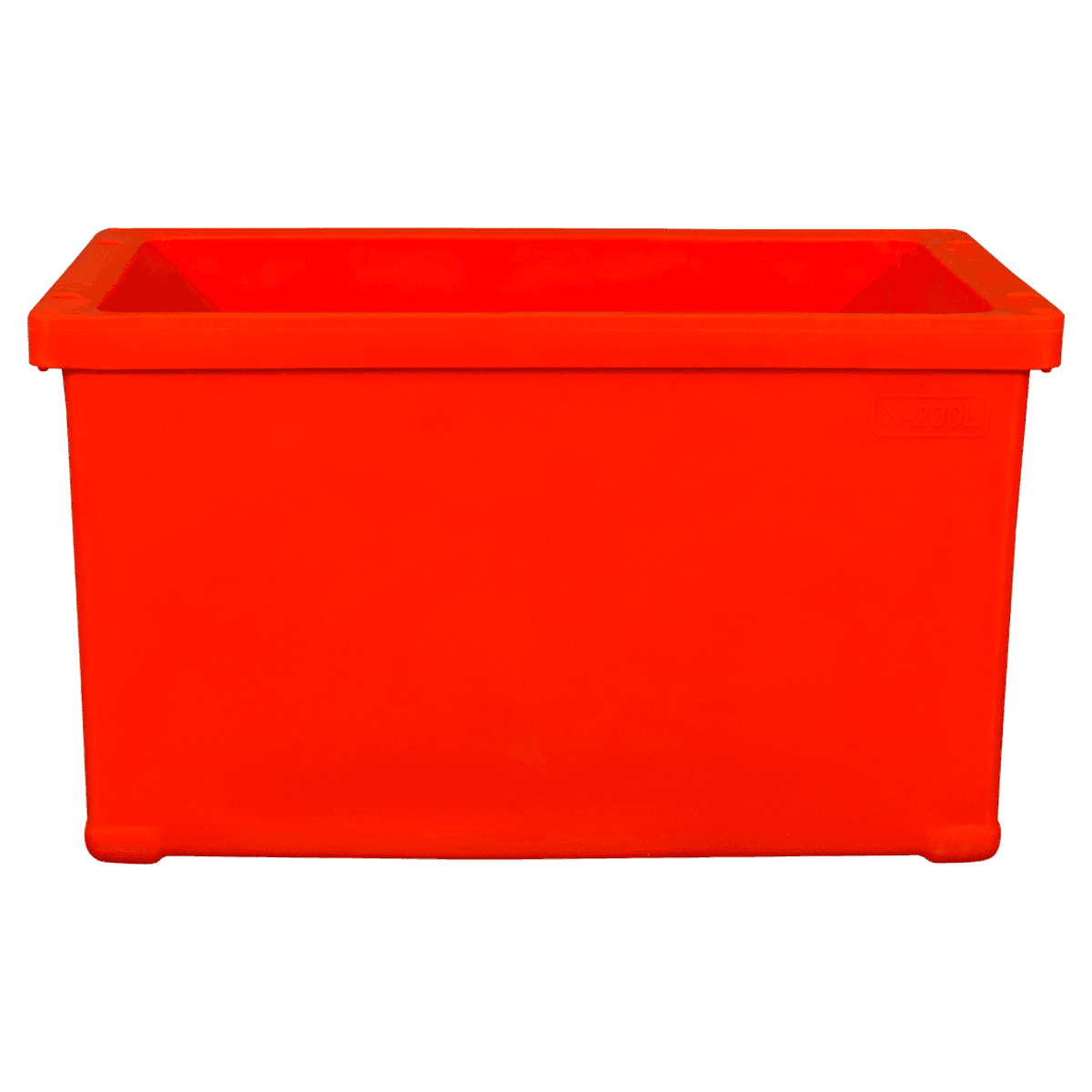
The phrase covers a wider family of products than most buyers expect. In practice, an agricultural container is any reusable rigid vessel used to harvest, hold, process, store or move farm-origin goods — and that includes goods that never touch soil, such as fish, poultry, dairy and aquaculture stock. The common thread is not the crop. It is the working environment: outdoor UV, repeated washdowns, forklift abuse, wide temperature swings, and constant contact with food.
Breaking the category into its functional jobs makes selection far easier than browsing by product photo.
Harvest and field crates
Light, stackable and usually vented so that field heat escapes instead of cooking the produce from the inside.
Bulk storage bins and totes
Large-format vessels for holding loose product between processing steps, sized around pallet and forklift dimensions.
Insulated and cold-chain containers
Double-walled units with a foam core that slow heat exchange during transport, staging and display.
Live haul and aquaculture tanks
Watertight vessels engineered for oxygen supply, flow and the physical wellbeing of live stock in transit.
Material handling and feed containers
General-purpose bins and buggies that move ingredients, by-products and waste around a busy site.
Nestable and collapsible crates
Empty-return containers that trade some rigidity for a much smaller backhaul footprint.
Notice how little overlap there is between these jobs. A crate that excels at blueberry harvest will be useless in a freezing room, and a heavy insulated tub that protects frozen product on a truck is an awkward thing to carry down a row of vines. The first real decision is therefore not brand or price. It is which job you are actually buying for.
The Six Structural Styles You Will Actually See
Once you are inside a working facility, the variety collapses quickly. Almost every container in daily use falls into one of six structural families, and each family comes with a characteristic failure mode worth knowing about.
| Structural style | Typical capacity | Primary job | Watch out for |
|---|---|---|---|
| Harvest lug or field crate | 10–50 L | Hand harvesting and grading | Thin walls cracking at the rim |
| Bulk bin or tote | 300–1,200 L | Loose product storage and hauling | Base flex under forklift load |
| Insulated bin or tub | 50–1,700 L | Temperature-sensitive cargo | Foam core moisture ingress |
| Pallet container | 500–1,200 L | Workshop and warehouse staging | Footprint mismatch with racking |
| Live haul tank | 200–1,700 L | Live fish and seafood transport | Poor lid sealing and oxygen loss |
| Nestable crate | 20–60 L | Empty container return logistics | Hinges and latches wearing out |
Two structural details separate containers that survive a decade from containers that survive a season. The first is wall thickness at the rim and the base corners, which is where impact and lifting stress concentrate. The second is how the base distributes load: a wide, gently radiused base spreads weight across the floor of the bin, while a narrow or sharply angled base concentrates it into a handful of stress points that eventually craze and split.
Materials: Where Most Buying Decisions Are Won or Lost
Material choice determines chemical resistance, low-temperature toughness, food-contact suitability and service life. It also determines repairability, which matters more than most buyers assume on a site where a cracked bin can often be repaired rather than replaced.
| Material | Strengths | Limitations | Typical use |
|---|---|---|---|
| HDPE | Rigid, economical, good chemical resistance | Can become brittle in deep cold | Crates, bulk bins, general handling |
| LLDPE | Excellent impact strength, flexible at low temperature | Lower stiffness than HDPE | Rotomolded insulated containers, tubs |
| Polypropylene | Higher heat tolerance, steam cleanable | Poor performance below freezing | Food-contact baskets, trays |
| Fiberglass | High stiffness, good for very large fixed units | Heavy, prone to delamination and repair problems | Oversized stationary tanks |
| Stainless steel | Very easy to sanitise, strong | Heavy, dents, conducts heat quickly | Processing benches, small specialty vessels |
For insulated and cold-chain applications, linear low-density polyethylene is the material most manufacturers reach for, and for good reason. It keeps its impact resistance at temperatures where HDPE starts to behave like a brittle ceramic, and it tolerates the repeated thermal cycling that a bin experiences when it moves from a freezer to a warm loading dock and back again. The trade-off is stiffness, which is normally recovered through design — ribbed walls, radiused corners and a moulded-in base structure — rather than through a different resin.
One practical point that rarely appears in specification sheets: pigment and UV stabiliser packages matter as much as the base resin. A container left on an open deck or in a yard for years takes a punishing ultraviolet dose, and a poorly stabilised formulation will chalk, fade and lose impact strength long before the polymer itself has reached the end of its life.
The Insulated Category Most Farms Overlook
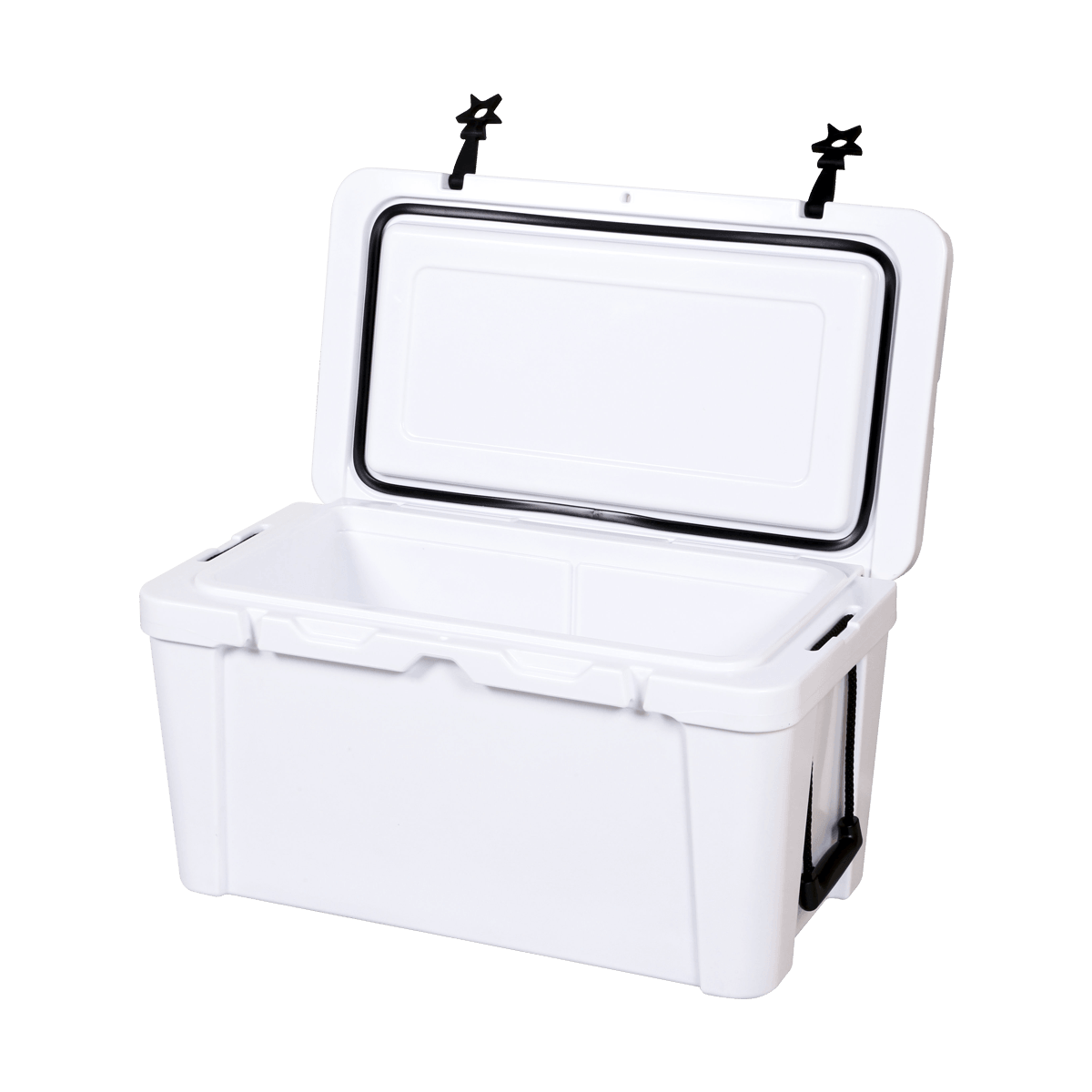
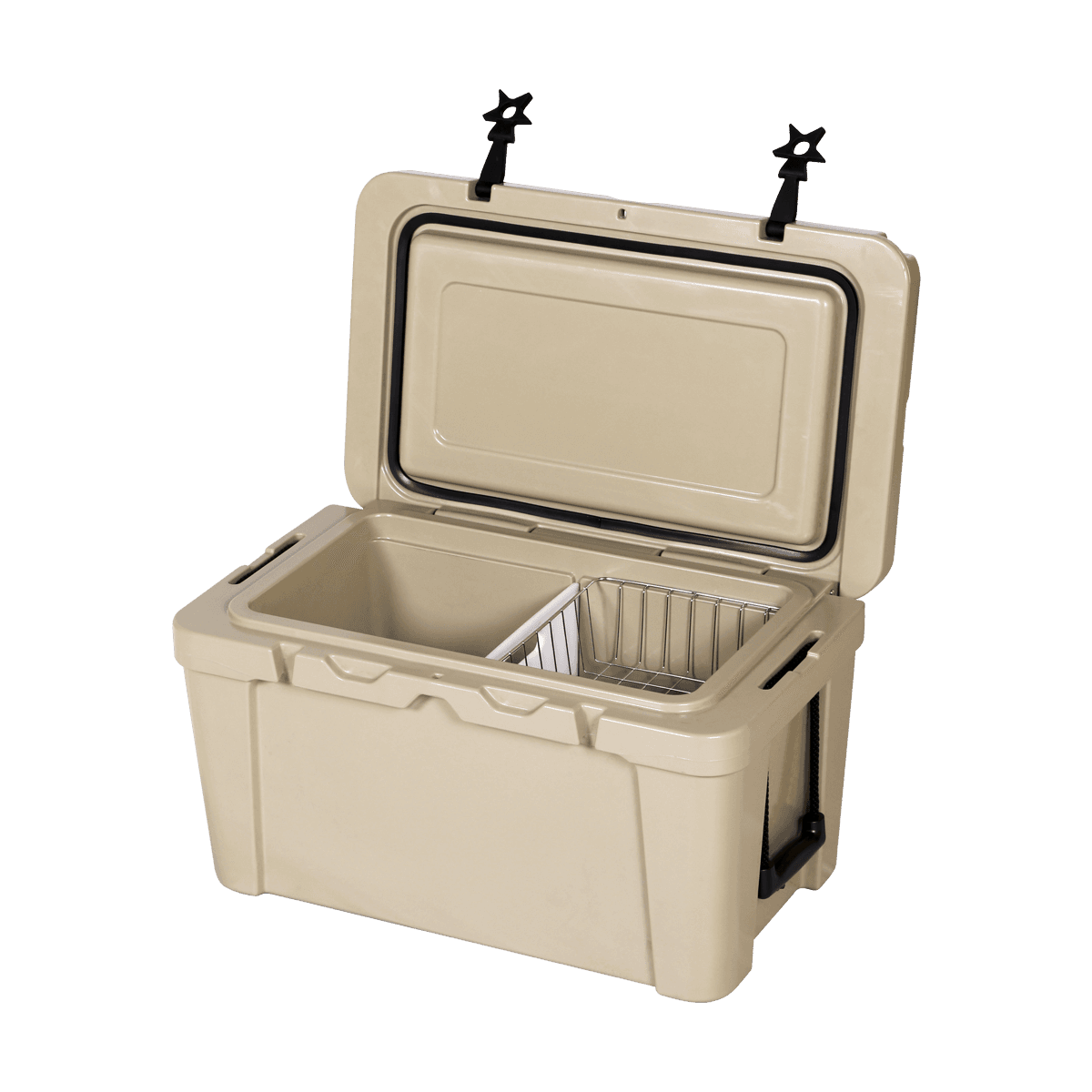
Insulated containers used to be considered a fish and pharmaceutical product. That has changed. Farms now move temperature-sensitive goods across distances and time windows that ordinary crates simply cannot cover, and the insulation is doing real work rather than providing a marketing label.
Step one: a sealed air gap
Early insulated boxes relied on a single trapped air space between two walls. Effective in still air, far less so once the container is loaded, stacked and moved.
Step two: polyurethane filling
The cavity between the inner and outer wall is injected with polyurethane, which closes the convection loop inside the gap and dramatically slows heat transfer.
Step three: seamless rotomolded double walls
The wall and the foam cavity are formed in one piece, so there is no joint at the rim or base where water and washdown chemicals can get in — a common failure point in welded or assembled containers.
Step four: purpose-built accessories
Lids with gaskets, casters, drainage points, stacking geometry and reinforced lifting points turn a generic box into a container that fits a specific workflow.
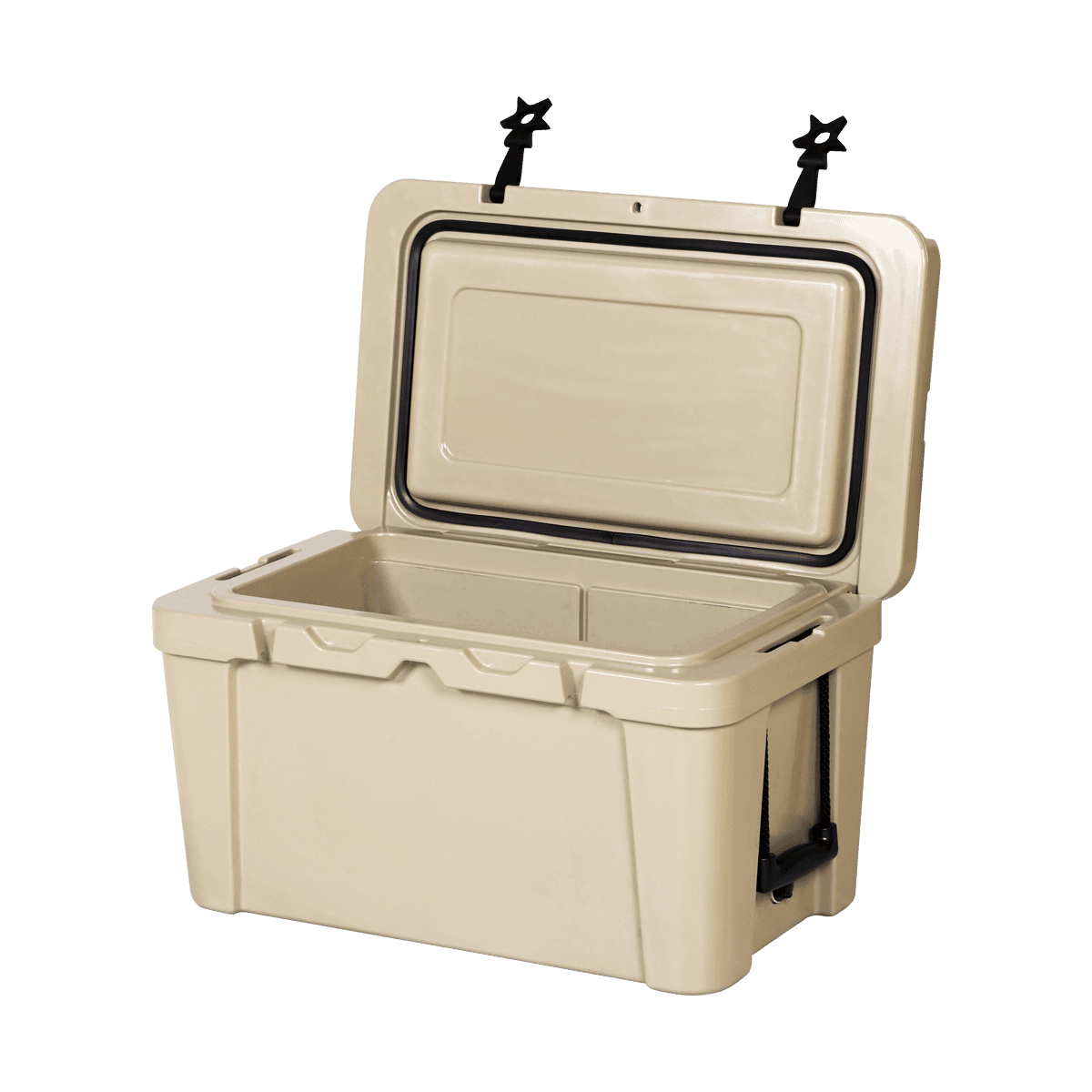
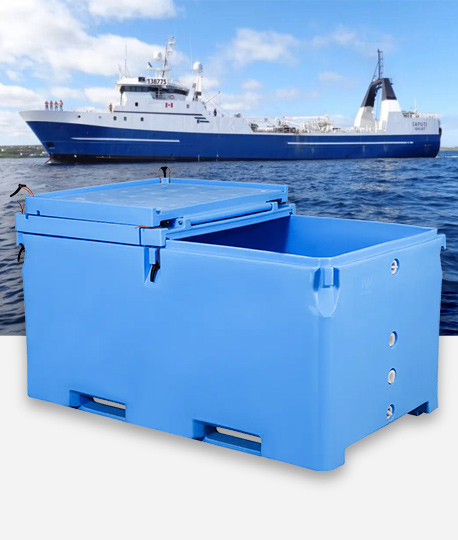
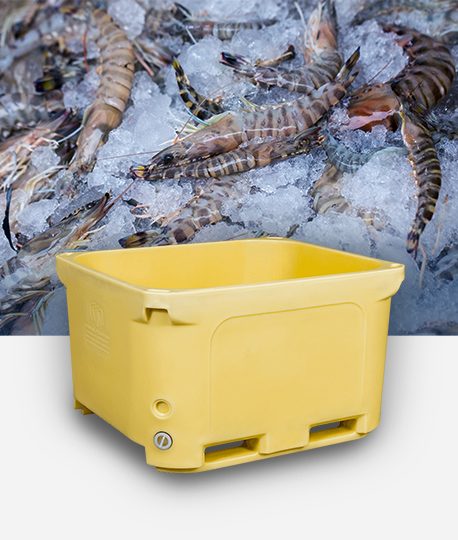
This matters across more applications than most people expect. Meat and poultry processors use wheeled insulated bins to move carcasses and cuts between chill rooms without breaking the cold chain. Seafood operations use insulated tubs, fish boxes and tote bins to hold catch on ice through auction, processing and distribution. Aquaculture sites use insulated tanks to keep live stock healthy and calm across long road transfers. Cold rooms and warehouse teams use pallet-mounted insulated containers as mobile staging units that hold temperature while product waits for the next process step.
 AF-1000L Insulated Plastic Bins for Meat and SeafoodThe AF-1000L is a 1000 L double-walled rotomolded bin with PUR insulation, built for hygienic handling of temperature-sensitive seafood, meat and poultry.View Product →
If your operation handles product where a two-degree drift changes the sale price — or the safety profile — insulated containers stop being a nice-to-have and start behaving like insurance.
Rotomolding, Injection Molding and Fiberglass Compared
Three manufacturing routes dominate the market, and each leaves a different fingerprint on the finished product.
Rotational molding
A measured charge of polyethylene is placed in a hollow mould, which rotates on two axes inside an oven. The resin melts, coats the interior and forms a seamless shell. The technique excels at double-walled and insulated parts, produces very uniform wall thickness and allows large formats that other processes struggle with.
Injection molding
Molten resin is forced into a closed tool under pressure. The result is high output, tight tolerances and excellent surface finish, which makes it ideal for small and medium crates, lugs and nesting baskets. It is less suited to thick insulating walls or very large single-piece vessels.
Fiberglass layup
Resin is applied over glass reinforcement by hand or spray. Very large and very stiff structures are possible, but the material is heavier, repairs are visible, and long-term exposure can lead to delamination at impact points.
What the choice means for you
For insulated, large-format, food-contact agricultural containers, rotational molding is generally the strongest technical fit. For lightweight field crates produced in very high volumes, injection molding usually wins on cost. Ask which process your supplier intends to use, because it explains most of the performance differences you will later notice.
Features Worth Checking Before You Commit
Specification sheets tend to list the same handful of adjectives. These are the details that actually change how a container behaves after the first month.
- Wall thickness at the rim. The rim absorbs most lifting and dragging impact. A thick, generously radiused rim is a reliable indicator of a container built for real work.
- Base design and forklift compatibility. Confirm the base matches the forklift or pallet jack you actually use, including the pocket depth and spacing.
- Stacking geometry. Loaded containers stacked four high must lock rather than slide. Test a stack of filled bins before placing a large order.
- Drainage and cleaning access. A container that traps water or product residue between uses will slow down every washdown and create hygiene risk.
- Lid sealing. For insulated units, the gasket and closure are frequently the weakest link in the thermal chain, whatever the wall construction claims.
- Handles and lifting points. Moulded-in handles distribute load better than bolt-on hardware, which loosens over time and leaves holes behind.
- UV stabilisation. Essential for anything stored outside, including containers that spend most of their life indoors but are occasionally parked in a yard.
- Attachments and mobile options. Casters, wheels, tow bars and nested dollies can turn a stationary bin into a mobile unit without a second purchase.
- Temperature range. Ask for the rated operating window, and be sceptical of any container described as suitable for all conditions.
- Food-contact documentation. Where the container touches food, request the material compliance documents relevant to your destination market.
Matching Containers to Real Farm and Food Scenarios
Buyers rarely have the luxury of choosing one container type for the whole site. Most working operations end up with a small toolkit of three or four styles, each tied to a specific zone. This table maps the most common scenarios to the styles that tend to perform best in them.
| Scenario | Recommended style | Priority features |
|---|---|---|
| Field harvest and grading | Vented lugs and nesting crates | Light weight, airflow, smooth internal surfaces |
| Meat and poultry processing | Wheeled insulated bins and carts | Hygienic finish, casters, temperature retention |
| Seafood handling and auction | Insulated tubs, boxes and tote bins | Ice retention, drainage, stacking strength |
| Cold room and warehouse staging | Pallet-mounted insulated containers | Forklift access, insulated lid, stackability |
| Live fish and aquaculture | Live haul tanks with oxygen support | Watertight body, oxygen system, low stress handling |
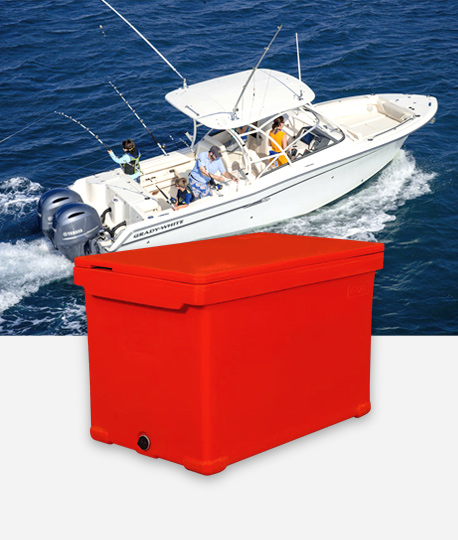
| Fishing vessels and docks | Heavy-duty ice boxes | Non-slip base, salt resistance, sealed lid |
 AF-1700L Insulated Bulk Container for Cold ChainA 1700 L food-grade rotomolded container with PUR insulation, suited to cold-chain transport, perishables and live seafood where temperature control matters.View Product →
Two habits make this mapping far more useful. First, walk the actual route your containers travel and note where they are lifted, tipped, washed and parked. Second, weigh the full container, not the empty one, because almost every handling injury and structural failure traces back to a load heavier than the container was specified for.
A Step-by-Step Selection Path
When a buyer asks where to begin, this is the sequence we recommend. It is deliberately ordered so that the cheap decisions come before the expensive ones.
- Define the load. Record the product type, the bulk density, the maximum weight per container and the temperature range it will experience.
- Define the movement. Note whether the container is carried by hand, dragged, forklifted, palletised, or moved on casters.
- Define the time window. Estimate how long product stays in the container before the next step, because that window drives the insulation decision.
- Define the wash routine. Identify the chemicals, water temperature and frequency of cleaning, since aggressive sanitation shortens the life of the wrong material very quickly.
- Shortlist two or three structural styles. Resist the temptation to standardise on a single container across the entire operation.
- Request samples and run them for a full shift. A container that feels fine when empty can behave very differently when full, wet and being loaded by a forklift operator in a hurry.
- Check documentation and compliance. Confirm the food-contact and material documentation meets the requirements of every market you ship into, not just your domestic one.
- Plan the replacement cycle. Ask the supplier for the expected service life and compare it against the purchase price. The cheapest container per unit is rarely the cheapest container per year of service.
Cleaning, Food Contact and Service Life
Containers that touch food live under two sets of obligations at once: they must be cleanable to a standard a health inspector will accept, and they must remain physically intact while being cleaned. Those goals occasionally pull in opposite directions, which is why cleaning design belongs in the purchase decision rather than the maintenance manual.
Smooth, seamless interiors with generous internal radii are much easier to sanitise than containers with sharp internal corners, deep ribs or crevices around the lid. Drainage should be complete: any pocket that holds a puddle after washing will eventually hold a biofilm. Where containers are cleaned with hot water or caustic chemicals, confirm that the polyethylene formulation used in the outer skin is rated for that exposure.
Service life is more predictable than most buyers expect. A thick-walled, seamless container that is loaded within its rated capacity and handled with reasonable care will typically deliver many years of daily use, and the parts most likely to wear first are the moving ones — lids, gaskets, hinge points and casters. Repairable containers with replaceable components usually justify a higher purchase price, because they spread the cost of ownership across the whole service life rather than concentrating it into the first year.
For operations that need a container built specifically around a handling or storage workflow, it is worth looking at dedicated insulated agricultural bins rather than adapting a general-purpose tub. Purpose-built units usually integrate better with existing pallet, racking and wash systems, which is where most day-to-day friction actually comes from.
Custom Sizing, Branding and OEM Supply
At some point the standard catalogue runs out of answers. A processor needs a container that fits an existing rack by two centimetres; a distributor wants a cooling box that matches a specific retail footprint; an exporter needs moulded branding and documentation for a private-label range. This is the point where a manufacturing partner matters more than a product list.
Custom work in this industry usually falls into a few predictable categories: adjusted external dimensions to fit racking or vehicle bays, modified wall thickness for a heavier rated load, alternate lid and closure configurations, drainage or oxygen fittings, and colour or branding applied during moulding rather than after it. Moulded-in branding survives far longer than any label, which is why it has become the default for fleet and rental container programmes.
 Custom AF-800L Insulated Container for Aquaculture OxygenationAn 800 L food-grade rotomolded insulated container for fish handling and recirculating aquaculture, with nanobubble oxygenation and OEM/ODM options.View Product →
When evaluating a custom supplier, ask about tooling approach, sample lead times, minimum order quantities and how design changes are handled once production begins. A manufacturer that can explain the moulding process in plain language, rather than quoting specifications at you, is usually the one worth working with. Our own OEM and ODM programme exists precisely because most serious buyers eventually need something that is not quite in the catalogue.
Frequently Asked Questions
Are plastic agricultural containers food safe?
Food-grade polyethylene containers are widely used for direct food contact and are generally accepted in food supply chains when the resin and additives meet the relevant regulatory standard for the destination market. Always request the material compliance documentation rather than relying on the general description of the product.
How long should an insulated container hold temperature?
It depends on the ambient temperature, the starting product temperature, how full the container is, and how often it is opened. A well-made insulated container with a foam-filled double wall and a sealed lid will significantly outlast a single-wall box of the same size, but no container holds temperature indefinitely. Test with your own product and route rather than relying on a generic rating.
Can containers be repaired if they crack?
Polyethylene containers can often be repaired by plastic welding, which makes them a cost-effective long-term investment. Cracks at the rim or base of a thin-walled container usually indicate that the unit has been overloaded, so repair should be paired with a review of how it is being handled.
Is insulated better than ordinary plastic?
Only when temperature matters. Insulated containers are heavier, bulkier and more expensive per litre, so they belong where the cold chain is genuinely at risk. For dry product, ambient harvest or short local movement, a standard container is usually the better and cheaper choice.
What is the most common mistake buyers make?
Underestimating the loaded weight and the loaded lifespan. Containers are frequently specified on empty weight and then loaded with product that is two or three times heavier than the design assumption. In our experience, that single mismatch accounts for more premature failures than material choice, moulding method or price combined.
Do containers work in both hot and cold climates?
Generally yes, but the resin and stabiliser package should be selected with the operating environment in mind. Polyethylene that performs well in a cold room may need additional UV and heat stabilisation for outdoor use in a tropical climate, and impact behaviour changes noticeably in sub-zero conditions.
Agricultural containers are one of the few pieces of equipment on a working site that touch every part of the operation — harvest, processing, storage, transport and cold chain — while remaining almost invisible in the budget. That invisibility is exactly why they are worth buying carefully. A container specified around the real load, the real route and the real temperature window will quietly deliver years of service. One specified around the lowest unit price will keep reminding you of the decision, usually at the worst possible moment.
Start with the work, not the catalogue. Define the load, the movement and the temperature window first, then let those three answers narrow the field. If you would like help working through a specific handling or cold-chain problem, our team is always glad to talk through the practical details.