English
 Español
 عربى
 中文简体
Content
Large storage plastic containers sit somewhere between packaging and equipment. They are the bins, totes, tanks and pallet boxes that hold a few hundred litres at a time, or a tonne of product, and they work on wet processing floors, in chillers, on trucks and on the decks of boats. Buyers rarely ask us for a big plastic box. They ask for something that will not crack in midwinter, that can be lifted full by a forklift without bowing, that keeps a pallet of chilled fish cold for six hours, and that still passes a hygiene inspection after five years of hard use.
That is the standard we have worked to since 2008, designing and rotomolding insulated containers at our factory in Ningbo. This guide covers the questions that come up most often when customers specify large containers, and the answers we usually give them.
What Counts as a Large Storage Plastic Container?
In industrial use, the line usually falls around 200 litres. Below that, most buyers think in terms of totes, boxes and crates. Above it, the questions change: how will the container be moved when it is full, how heavy is it empty, and can two people lift it onto a pallet or a truck bed? The bands below are roughly how customers divide the market.
| Band | Typical volume | Where it usually ends up |
|---|---|---|
| Medium | 200-400 L | Fish tubs, ingredient bins, wheeled meat carts |
| Large | 500-800 L | Bulk seafood bins, stackable food bins, insulated totes |
| Extra large | 1000-1200 L | Insulated bulk containers, refrigerated storage tanks, pallet containers |
| Oversized | 1500-1800 L | Boat and dock ice boxes, tuna storage, bulk cold-chain transport |
Litres are only part of the story. Usable volume shrinks once a lid, a drain fitting or a thick insulated wall is added, and outside dimensions matter as much as inside ones. A 1000 litre container that does not fit a standard pallet footprint or a truck bay costs money every time it is handled. When we quote a large container, we ask for four numbers: length, width, height and the load it has to carry.
At the top of the range, an extra-large boat container shows how far this can go:
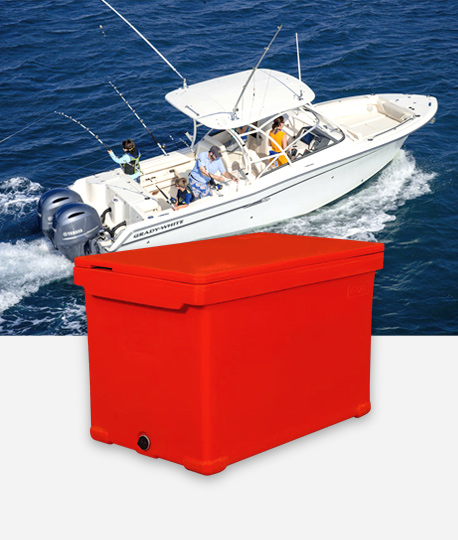
 AF-1700L Extra Large Insulated Boat Container for Live SeafoodExtra-large rotomolded polyethylene container with PUR insulation, designed for onboard handling and transport of live lobster and tuna.View Product →
Materials, Molding and Insulation
Almost every large container is made from polyethylene, but not all polyethylene behaves the same way. Linear low density polyethylene is the usual choice for rotomolded containers because it tolerates impact at low temperatures far better than a rigid, brittle material would. A fish bin dropped onto a frozen quay should dent, not shatter.
Rotational molding lets the wall, the base and the rim form in one piece. Double-wall containers made this way have no seam for water to enter and no joint for bacteria to hide in. On insulated models, the cavity between the two walls is filled with polyurethane foam, which slows heat transfer and stiffens the structure, so a large container carries more weight without extra ribs.
What decides insulation performance
- Foam density and how evenly the cavity is filled
- The gap between the inner and outer wall
- Lid fit and gasket design, since much of the heat leaves through the top
- Surface area against volume, which is why a 1000 litre unit holds temperature longer than a 50 litre box
A single-wall container is still the right answer for dry goods, ambient storage and jobs where weight matters more than temperature. Matching the construction to the task is cheaper than over-specifying, and we say so even when it means quoting a simpler product.
Matching the Container to the Work
Large containers are bought by industry rather than by category, so the deciding factors are usually what goes inside and how it moves.
Seafood and meat processing
Tubs, tanks and bins for seafood need smooth internal corners, a drain that empties completely, and a wall that will not absorb fish oil or blood. Stackability matters, because a processing hall usually holds more product than floor space suggests. In meat and poultry plants, wheeled carts and food production containers do similar work on a different route, moving product between stations under strict hygiene rules.
Cold chain, workshops and warehouses
Insulated pallet containers and bulk bins hold temperature between two points in a process: from the blast freezer to the dispatch bay, from the delivery truck to the cold room. They also add temporary capacity when a chiller is full. Because they are handled by pallet trucks and forklifts all day, the base, the corners and the hinges take more punishment than the walls.
Agriculture, ice and bulk ingredients
Agricultural bins carry harvests, feed and ice, often outdoors. UV exposure and rough ground are the main enemies here, so wall thickness and protected hardware matter more than insulation value.
Boats, docks and live haulage
On a vessel, a container has to cope with salt water, spray, sun and constant movement. Ice boxes and oversized dock containers are built with more wall thickness and heavier fittings. For live seafood, insulated tanks add aeration and oxygen supply so that fish and shellfish arrive in condition, not merely alive.
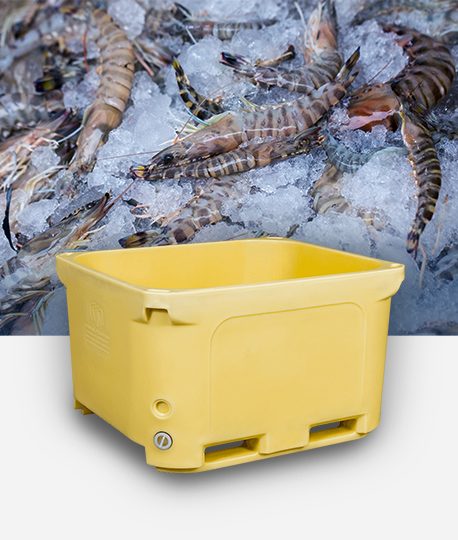
 AF-1000L Insulated Fish Tote for Industrial Seafood HandlingDouble-walled LLDPE and PU insulated container with forklift and pallet-jack access, suited to fresh seafood handling and transport.View Product →
Size, Shape and Handling: A Practical Checklist
Most of the failures we see in the field are not caused by bad material. They are caused by a container specified one size too large, or without enough thought about how it will be lifted and emptied. Before ordering, it helps to answer a few questions.
- What is the maximum weight the container will hold, including ice or liquid?
- How will it be moved: by hand, pallet truck, forklift or crane? Are fork entries needed on two sides or four?
- Does it have to fit a standard pallet, a racking system, a truck bay or a specific deck space?
- Will it be stacked when full, when empty, or not at all, and how high?
- Does it need a drain, a lid, casters, a gasket or a locking ring?
- What temperature range will it see, and is insulation required?
- How will it be cleaned: pressure washing, chemical wash or steam?
The answers narrow the choice quickly. A plant that pressure washes every day will prefer a smooth, one-piece container with a generous radius on the drain. A distribution warehouse stacking 1000 litre units four high needs to know what compression load the base can take, which is a matter of wall thickness and foam density rather than brochures. Many customers in this range start by comparing insulated bulk storage containers before they look at anything unusual.
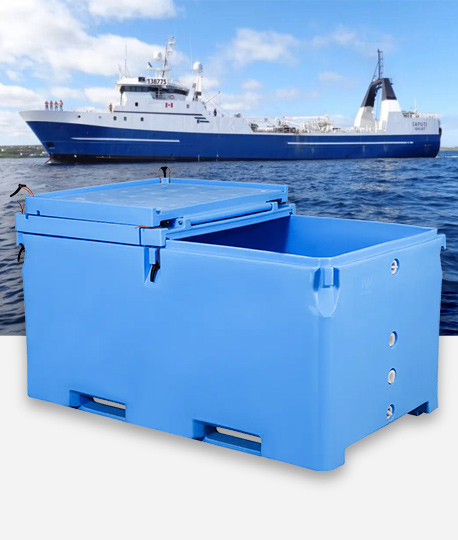
 AF-1000L Solid Insulated Pallet Container for Cold-Chain StorageDouble-walled food-grade LLDPE and PUR pallet container for temperature-sensitive seafood and frozen goods in warehouse cold-chain logistics.View Product →
Food Contact, Cleaning and Service Life
Any container that touches food has to be made from materials that meet food contact requirements, and the finished surface has to be cleanable. Our containers are produced to national food hygiene standards, and the same rule of thumb applies anywhere: a surface that cannot be cleaned will eventually cause a problem, whatever the material certificate says.
In practice, service life comes down to a few habits. Rinse before residue dries. Avoid metal scrapers that score the surface. Check gaskets and lid seals, because a worn seal is the most common reason an insulated container stops performing. Keep an eye on caster mountings and handles, which are usually the first parts to need replacement.
Well-made rotomolded containers stay in service for many years and can often be repaired rather than replaced. That matters for cost, and increasingly for the sustainability reporting that larger customers have to produce. A container that lasts ten years instead of two is a straightforward reduction in waste.
What to Ask a Rotomolding Supplier
Large containers are rarely bought off a shelf. Wall thickness, foam density, hardware and dimensions are usually tailored to the application, and the difference between a good supplier and a cheap one shows up in the details.
- Can they confirm wall thickness and foam density in writing?
- Is the body molded in one piece, and how are any inserts sealed or reinforced?
- Which fittings are used for hinges, drains, handles and casters, and are spares available?
- Can they produce a sample or pilot batch before full tooling?
- Do they offer custom dimensions, private labelling and OEM production?
- What is the lead time, and how is quality checked between batches?
We have been making rotomolded insulated containers since 2008, with more than 50 products shipped to over 40 countries, and our OEM and ODM work is where most of these conversations begin. Bring a drawing, a sample or simply the problem you need to solve; working backwards from the application is faster than choosing from a catalogue.
If you are sizing a container for a new line, replacing something that failed, or trying to fit more cold storage into the same floor space, the useful starting point is the job itself: what goes in, how much it weighs, how it moves, and what temperature it has to hold. Get those four things right and the container tends to choose itself. If you would like a second opinion on a specification, our team is glad to talk it through, whether it turns into an order or not.